

告别走位偏差!现代自动化运动控制精度提升方案(中英文)
提升现代自动化控制精度
Enhancing Control Precision in Modern Automation
在当今的自动化环境中,精确的速度和位置控制对于确保机器和系统以最佳性能运行至关重要。无论是移动机械臂、控制传送带,还是使用起重机进行提升,精确的电机反馈都能确保一切按预期运行。编码器正是在此发挥作用,它将运动转换为可用数据,从而实现更智能、更灵敏的控制。
In today’s automation environments, accurate speed and position control is essential to keeping machines and systems running at peak performance. Whether you're moving a robotic arm, indexing a conveyor, or lifting with a hoist, precise motor feedback is what ensures everything moves exactly as intended. That’s where encoders come in, converting motion into usable data that enables smarter, more responsive control.
为什么编码器在运动系统中至关重要
Why Encoders Matter in Motion Systems
变频驱动器 (VFD) 控制电机转速和扭矩,但如果没有编码器,它只能估算实际性能。编码器提供关键反馈,实现闭环控制。这使得 VFD 能够确认电机轴的运行状态并立即进行调整。最终实现:稳定的转速、精确的定位和更高的系统重复性。
以下应用最能受益于编码器:
• 对速度要求极高的机器:包装线、龙门架、自动化立体仓库 (ASRS)、分度机、升降机和高速起重机
• 精确定位系统:取放机器人、线性龙门架、ASRS
• 同步轴:印刷线、包装机械、传送带式装配、飞锯、凸轮
A Variable Frequency Drive (VFD) controls motor speed and torque, but without an encoder, it can only estimate actual performance. Encoders provide critical feedback, enabling closed-loop control. This allows the VFD to confirm what’s happening at the motor shaft and make immediate adjustments. The result: consistent speed, precise positioning, and better system repeatability.
Applications that benefit most from encoders include:
• Speed-critical machines: Packaging lines, gantries, storage and Retrieval Systems (ASRS), Indexing Machines, Lifts and high-speed hoists
• Precise positioning systems: Pick-and-place robotics, linear gantries, ASRS
• Synchronized axes: Printing lines, packaging machinery, conveyor-based assembly, flying saws, caming
编码器的类型及其使用时机
Types of Encoders and When to Use Them
编码器通常分为两类:电机安装式和外部式,具体取决于反馈信号在系统中的采集位置。
电机安装式编码器:源头精度
电机安装式编码器直接安装在电机后端,可提供速度、位置或两者的实时反馈。由于它们固定在电机轴上,因此能够提供精确、无延迟的反馈——非常适合负载随电机直接移动的情况。
常见应用场景:
• 工业齿轮箱驱动机械
• 直驱系统
• 分度工作台
• 伺服轴
功能优势
• 精确的速度控制:即时反馈使变频器 (VFD) 能够保持精确的设定值。
• 精确定位:支持可重复的启动/停止点。
• 集成设计:结构紧凑、防护可靠,尤其是在嵌入电机风扇中时。
编码器改造和双反馈
并非所有应用都从编码器反馈开始。如果速度或定位需求发生变化,加装电机编码器是一种经济高效的升级方案。
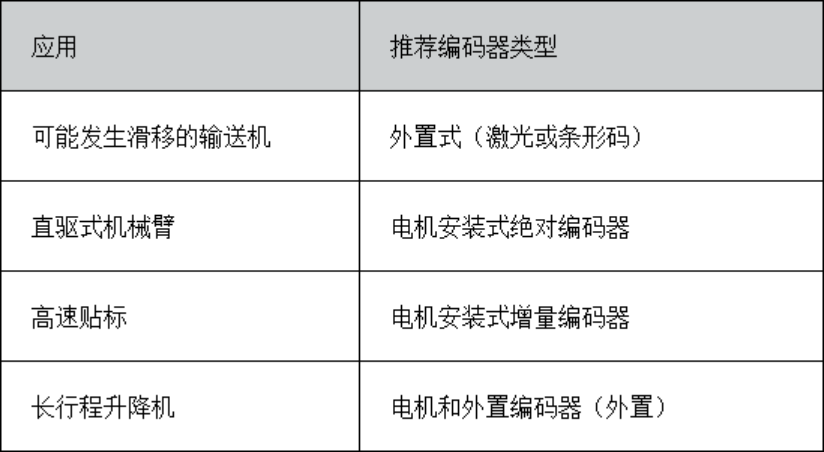
在更复杂的系统中,双编码器配置(电机编码器 + 外部编码器)有助于确保动态响应和最终负载精度。电机编码器提供快速反馈;外部编码器验证实际负载位置,这对于存在滑移、拉伸或柔性的系统至关重要。
接口选项
电机编码器有多种格式,包括 TTL、HTL、正弦余弦以及数字接口。请确保编码器和变频器 (VFD) 使用兼容的接口。MOVI-C® 等平台开箱即用,支持多种标准,简化了设置。
Encoders generally fall into two categories: motor-mounted and external, depending on where feedback is captured in the system.
Motor-Mounted Encoders: Precision at the Source
Motor-mounted encoders attach directly to the back end of a motor and provide real-time feedback on speed, position, or both. Because they’re fixed to the motor shaft, they offer accurate, delay-free feedback—ideal when the load moves directly with the motor.
Common use cases:
• Industrial gearbox-driven machinery
• Direct-drive systems
• Indexing tables
• Servo axes
Functional Benefits
• Tight Speed Control: Immediate feedback allows the VFD to maintain accurate setpoints.
• Accurate Positioning: Supports repeatable start/stop points.
• Integrated Design: Compact, protected, and reliable, especially when embedded in the motor fan.
Encoder Retrofitting and Dual Feedback
Not every application starts with encoder feedback. If speed or positioning needs change, retrofitting a motor encoder can offer a cost-effective upgrade.
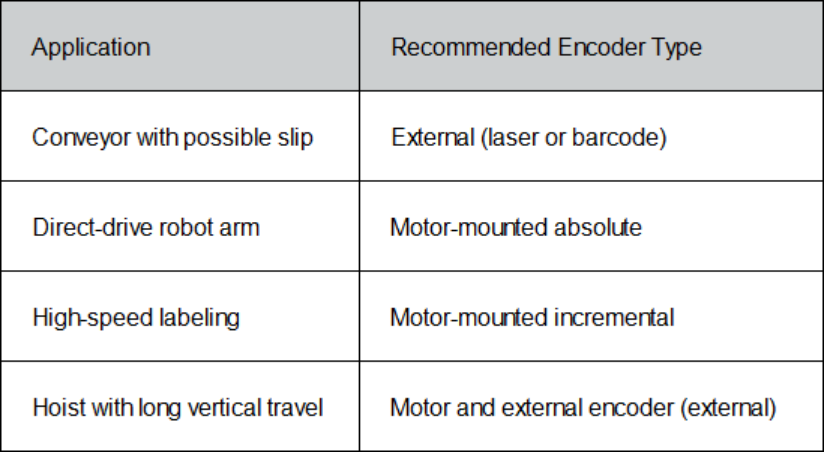
In more complex systems, a dual encoder setup (motor + external) helps ensure both dynamic response and final load accuracy. The motor encoder handles fast feedback; the external encoder validates actual load position, which is critical in systems with slip, stretch, or compliance.
Interface Options
Motor encoders come in various formats, including TTL, HTL, sine-cosine, and digital interfaces. Make sure the encoder and VFD share compatible interfaces. Platforms like MOVI-C® support multiple standards out of the box, simplifying setup.
外部编码器:基于负载的反馈,实现实际精度
电机编码器假设负载和电机同步运动,但皮带、联轴器和齿轮间隙会引入滑移或延迟。外部编码器直接在负载处测量运动,确保位置的真实精度。
常见的外部编码器类型:
• 激光编码器:利用反射激光束计算距离。适用于非接触式、洁净室或远距离应用。
• 绳索编码器:利用可伸缩的钢丝绳和卷轴跟踪直线或垂直运动。常用于起重机和恶劣环境。
• 条形码线性编码器:读取轨道上的印刷条形码以确定绝对位置。常用于高架输送机和装配线。
何时使用外部编码器:
• 皮带驱动系统容易打滑
• 长线性轴或起重机
• 受齿轮间隙影响的系统
• 需要验证负载实际位置的应用
主要功能优势:
• 精确的负载定位
• 对间接或直线运动至关重要
• 提高双反馈系统的精度
集成注意事项
并非所有驱动器都支持双编码器。
External Encoders: Load-Based Feedback for Real-World Precision
Motor encoders assume the load and motor move together—but belts, couplings, and gear lash can introduce slip or delay. External encoders measure motion directly at the load, ensuring true position accuracy.
Common types of external encoders:
• Laser Encoders: Use a reflected laser beam to calculate distance. Ideal for non-contact, cleanroom, or long-range applications.
• Rope Encoders: Track linear or vertical motion using a retractable cable and spool. Common in hoists and rugged environments.
• Barcode Linear Encoders: Read printed barcodes along a track to determine absolute position. Often used in overhead conveyors and assembly lines.
When to use external encoders:
• Belt-driven systems are prone to slip
• Long linear axes or hoists
• Systems affected by gear backlash
• Applications where the load's actual position must be verified
Top Functional Benefits:
• Accurate Load Positioning
• Critical for Indirect or Linear Motion
• Enhanced Precision in Dual Feedback Systems
Integration Considerations
Not all drives support dual encoders.
增量式编码器与绝对式编码器:如何选择合适的编码器
Incremental vs. Absolute: Choosing the Right Encoder for the Job
选择合适的编码器取决于系统需要获取哪些信息。增量式编码器非常适合速度和位置反馈,因为这些反馈无需频繁参考;而绝对式编码器即使在断电等情况下也能提供绝对位置数据。了解它们的区别有助于确保系统性能的准确性和高效性。
Choosing the right encoder comes down to what your system needs to know. Incremental encoders are ideal for speed and positioning feedback which do not need to be often referenced, while absolute encoders provide absolute position data even after power outages etc. Understanding their differences helps ensure accurate, efficient system performance.
增量式编码器
增量式编码器是一种位置传感器,它将旋转运动转换为一系列电脉冲。当电机轴旋转时,编码器会产生等间隔的脉冲(通常称为“增量”),控制系统利用这些脉冲来计算速度、方向和相对位置。由于其结构简单且经济高效,增量式编码器非常适合基于速度的应用。
常用接口类型包括:
• TTL / HTL(方波)
• 正弦余弦(高分辨率模拟插值)
分辨率以每转增量 (IPR) 衡量,IPR 越高,速度控制越精确。
Incremental Encoders
An incremental encoder is a type of position sensor that converts rotary motion into a series of electrical pulses. As the motor shaft turns, the encoder generates evenly spaced pulses, often called “increments”, that the control system uses to calculate speed, direction, and relative position. They're ideal for speed-based applications due to their simplicity and cost-effectiveness.
Common interface types include:
• TTL / HTL (square wave)
• Sine-Cosine (analog interpolation for high resolution)
Resolution is measured in increments per revolution (IPR), with higher IPR delivering more accurate speed control.
绝对式编码器
绝对式编码器是一种位置传感器,它为每个轴位置提供一个绝对数字值,因此即使在断电重启后,它也能始终知道轴的精确位置。绝对式编码器不发送脉冲,而是为每个轴位置发送一个唯一的数字值。启动时,系统会立即确定轴的位置,无需回零或参考程序。
• 单圈:跟踪轴在一个 360° 旋转周期内的位置。
• 多圈:跟踪多个旋转周期内的位置,计数可达数百万,非常适合长时间线性应用。
常用接口包括:
• Hyperface® / RS485:双通道——数字绝对位置和正弦余弦速度数据。
• MOVILINK® DDI:也支持单电缆架构中的绝对数据。
Absolute Encoders
An absolute encoder is a type of position sensor that provides an absolute digital value for each shaft position, so it always knows the exact position, even after a power cycle. Instead of pulses, absolute encoders transmit a unique digital value for each shaft position. Upon startup, the system immediately determines the shaft position, eliminating the need for homing or referencing routines.
• Single-Turn: Tracks shaft position over one 360° rotation.
• Multi-Turn: Tracks position across multiple rotations, up to millions of counts, ideal for extended linear applications.
Common interfaces include:
• Hyperface® / RS485: Dual-channel—digital absolute position and sine-cosine speed data.
• MOVILINK® DDI: Also supports absolute data in single-cable architectures.
工程注意事项
为了正确集成编码器,工程师必须验证:
• 变频器兼容性——并非所有变频器都支持编码器输入。
• 接口匹配——编码器和变频器必须使用兼容的电气接口。
• 布线基础设施——布线必须支持信号类型(TTL、正弦余弦、数字总线)并保持信号完整性,尤其是在长距离布线或噪声环境下。
Engineering Considerations
To properly integrate an encoder, engineers must verify:
• VFD Compatibility – Not all VFDs accept encoder inputs
• Interface Matching – The encoder and VFD must share compatible electrical interfaces.
• Cabling Infrastructure – Cabling must support the signal type (TTL, sine-cosine, digital bus) and maintain signal integrity, particularly over long runs or in noisy environments.
那么旋转变压器呢?
What About Resolvers?
虽然严格来说旋转变压器并非编码器,但它们的作用类似。这些模拟器件非常耐用且经济高效,常用于伺服应用中,因为这些应用对环境的适应性要求不高,且只需要基本的位置数据。它们非常适合恶劣或高冲击环境,但分辨率不如数字编码器。旋转变压器常用于伺服电机中。
While not technically encoders, resolvers serve similar purposes. These analog devices are highly durable and cost-effective, often used in servo applications where environmental ruggedness and basic position data suffice. They’re well-suited for harsh or high-shock environments, though they lack the high resolution of digital encoders. Resolvers are commonly used in servo motors.
结语
Final Thoughts
编码器是现代自动化实现精确、可重复运动的关键。无论是控制速度、位置还是两者兼顾,了解不同编码器类型及其与驱动平台的集成方式,都有助于确保系统发挥最佳性能。
Encoders are key to achieving precise, repeatable motion in modern automation. Whether you’re controlling speed, position, or both, understanding the differences between encoder types and how they integrate with your drive platform helps ensure your system performs at its best.
声明:
-文章转载自SEW,由爱泽工业翻译,如有侵权,请联系删除!
-如有偏颇,欢迎指正!

 沪公网安备31011002006738号
